
2026 Silver Winner
Interface & User Experience
Rippling
Entrant: Zilu He
2026
Silver
A closer look
Project gallery.
Select a thumbnail to browse. Click the main image to enlarge.
CategoryInterface & User Experience
Class / SubcategoryUser Experience (UX)
Interior & Architecture UX
Interior & Architecture UX
Country / Region United States
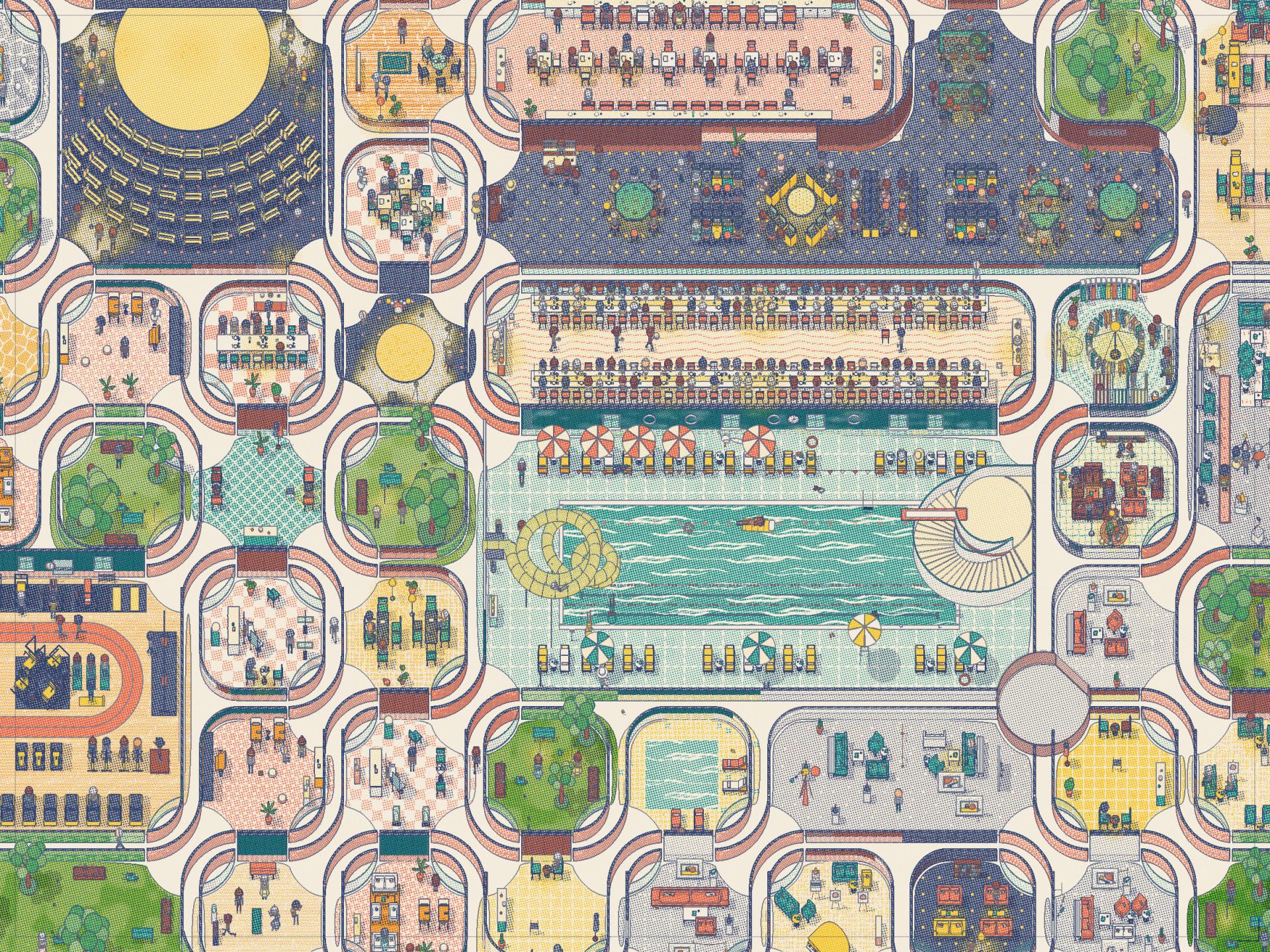
In Rippling, seeing someone can be the reason you miss them. A woman glimpses a man through a revolving door and pauses. A visitor reaches the threshold first and turns it; the woman misses the man in the lounge. With the door turned beforehand, she does not see him, keeps walking, and reaches the lounge before he leaves.
This browser-based interactive architectural film explores how visibility, access and timing shape encounters. Developed from research into sociality and isolation, it brings a proposed building in Causeway Bay, Hong Kong, to life through six protagonists and three interwoven storylines.
The building contains 101 rooms and 67 revolving doors. Its lower level interweaves two distinct circulation systems: a matrix of rooms requiring passage through shared spaces, and corridors permitting more independent movement. Revolving doors connect one pair of rooms while separating another. An open upper platform lets occupants observe the activity below, making observation itself a spatial relationship.
Viewers can follow an individual or a pair, pause to inspect the plan, and turn doors before they affect the story to explore different consequences. A timeline supports revisiting moments; selective color and linework on tracing paper connect individual encounters to the wider building.
Each room is conceived as a story within the building’s larger narrative. In paired libraries, individual reading lamps support quiet concentration, while a shared lamp gathers listeners around a storyteller. In the communal dining room, two newcomers cannot find adjacent seats until a family shifts along the table. These choreographed scenes explore how furniture, light and proximity shape opportunities for solitude and togetherness.
Rippling offers an experiential way to examine architecture through the encounters it enables, the solitude it allows, and the lives it brings into view.
Explore the project.
Project credits.
Mark Anderson
Thesis advisor, University of California, Berkeley
Raveevarn Choksombatchai
Thesis advisor, University of California, Berkeley
Keep exploring
More winning perspectives.
2026 Silver Winner
Memory Tree - Ginkgolink
Shirui Wang2026 Silver Winner
Wenchang Blessings of Fortune & Prosperity
Lijiang BSF Silver Jewelry Co., Ltd.Your work belongs in the conversation.
Begin Your Entry